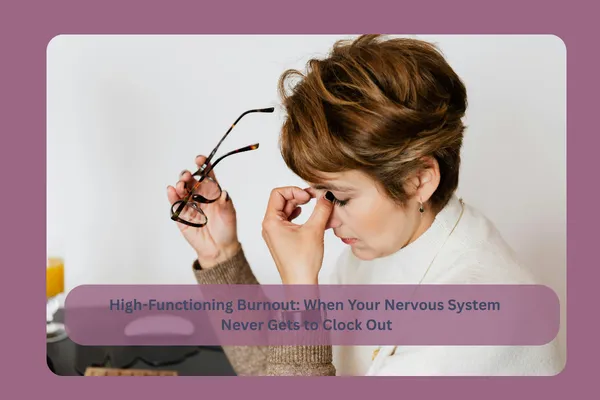
High-Functioning Burnout: A Nervous System Guide
There is a kind of burnout that rarely gets named, mostly because it does not look like what we have been taught burnout is supposed to look like. It does not show up as a dramatic collapse or an obvious breaking point, and it certainly does not come with a moment where everything stops and the world finally gives you permission to rest.
Instead, it shows up quietly, almost invisibly, inside women who are still functioning, still producing, still showing up for everyone around them, and still appearing successful from the outside.
This is what I call high-functioning burnout, and it is one of the most common patterns I see in high-achieving professional women, because it is not the kind of stress that registers as stress. It is the kind of stress that has simply become normal.
It is the low-level rush that lives underneath your days, the constant mental activation that never fully turns off, the sense that even when you are technically resting, your body is still bracing.
And over time, your nervous system never gets to clock out.
The Stress That Doesn’t Feel Like Stress Anymore
Most women I work with would never describe themselves as burned out. They are far more likely to tell me that they are just tired, that it is a busy season, that they are fine but stretched, that they simply need to get through the next few weeks.
And I understand why, because when you are a capable woman, when you are used to carrying a lot, when you have built a life that requires you to stay sharp and steady, you learn how to normalize a level of activation that your body was never designed to sustain.
You do not feel stressed in the traditional sense, because you are not panicking or falling apart.
You are just always on. Always thinking. Always managing. Always anticipating what is next.
And that is exactly why this kind of burnout is so easy to miss.
Burnout Doesn’t Start With Collapse, It Starts With Cognitive Overload
One of the most important shifts I want women to understand is that burnout rarely begins with a breakdown. It begins much earlier, often in the form of cognitive overload, when your brain is carrying too many tabs at once, when your nervous system is processing constant input, and when your life has no real downshift built into it.
It starts when your days are filled with decision after decision, meeting after meeting, role after role, and you move through it all so efficiently that no one questions whether it is costing you something.
But your body knows. Your nervous system knows. Because the stress response is not only triggered by crisis. It is triggered by constant demand without completion.
And eventually, the body starts adapting to a pace that it cannot metabolize.
What High-Functioning Burnout Does to Your Hormones and Health
This is where so many women become confused, because high-functioning burnout does not stay in your mind. It does not remain a mental state. It becomes physiology.
When your nervous system is stuck in low-grade activation, your stress hormones, especially cortisol, begin to shift out of rhythm, and that affects everything downstream, including progesterone production, thyroid signaling, blood sugar regulation, sleep architecture, inflammation, and cycle stability.
This is why women often come to me saying they feel “off,” but they cannot quite explain why.
Their PMS feels more intense than it used to.
Their sleep becomes lighter, more fragmented, less restorative.
Their cycles change.
Their anxiety feels hormonal.
Their energy feels unpredictable.
And they start wondering if something is wrong with them.
What I want you to hear clearly is that your body is not failing.
Your body is responding intelligently to chronic activation
My Own Story: The Burnout That Didn’t Look Like Burnout
And I want to pause here, because I cannot teach this as theory. I have lived it.
There was a season of my life where I was doing all the right things on paper. I was working hard, serving women, building something meaningful, showing up for my patients, showing up for my family, trying to hold everything with excellence.
I was also picking up my grandkids, caring for my mother in her nineties as Alzheimer’s began to change what life looked like, and trying to be the steady one for everyone around me.
And I remember realizing that my body never felt off-duty.
Even when I was home, even when I was technically resting, my nervous system was still running.
I was still thinking. I was still managing. I was still bracing.
It did not feel like burnout, because I was still functioning. But I was not replenishing.
And that is what high-functioning burnout does. It convinces you that because you are capable, you are fine, when in reality your body is quietly paying the cost of being the one who can always handle it.
That is why I care so deeply about naming this.
Because I know how many women are living inside it without language for it.
Why You Still Look Fine While You Feel Depleted
High-functioning burnout is particularly dangerous because it is invisible. You still show up. People still compliment you. You still perform. You still lead.
But internally, it often feels like you cannot fully relax, even on weekends, and rest does not restore you the way it should.
Your brain feels loud at night. Your joy feels muted. Small tasks feel heavier than they used to. You are accomplishing, but you are not recovering.
And your nervous system never gets the signal that it is safe to stand down.
The Early Sign Most Women Miss: Decision Fatigue
One of the earliest physiological signs of burnout is not exhaustion, it is decision fatigue.
When your nervous system is overactivated, your brain begins conserving energy by making everything feel harder.
Suddenly small choices feel overwhelming, your tolerance gets lower, your clarity disappears, and you start procrastinating things you normally handle with ease.
This is not laziness.
This is saturation.
This is your body asking for fewer inputs, not more discipline
This Is Not a Self-Care Conversation, It Is a Leadership Physiology Conversation
This is why I am not interested in framing burnout as a self-care issue. Burnout is not a bubble bath deficiency. It is not a mindset failure.
It is often the biological result of living in constant output without nervous system completion.
And for high-achieving women, this becomes a leadership issue, because you cannot sustainably lead from a body that is always bracing.
You cannot build a life of impact while your physiology is stuck in survival.
That is the deeper conversation we need to have. Not about doing more wellness tasks. But about learning how to downshift again.
A New Definition of Success
High-functioning burnout forces a deeper question. What does it mean to be successful, if your body never gets to feel safe inside that success? That is the heart of BioAligned Leadership.
Not performing wellness. Not chasing trends. But learning how to lead from a regulated body, a supported nervous system, and an energy that is sustainable.
What Actually Helps (That No One Is Talking About)
And this is the part of the conversation where I want to be careful, because I know what you’ve already heard.
You’ve already been told to sleep more, drink more water, take a bath, do yoga, book a massage.
And those things can be supportive.
But high-functioning burnout is not usually a hydration problem.
It is a nervous system flexibility problem.
It is what happens when your body never completes the stress cycle, when you move from task to task and role to role without any signal that it is safe to stand down.
So instead of giving you more self-care homework, I want to offer a few things that are quieter, more biological, and honestly… far more effective.
One of the most overlooked shifts is learning how to complete stress, not just manage it.
Sometimes that looks like taking ninety seconds after a hard moment to physically discharge what your body just held, whether that’s shaking out your arms, walking briskly around your house, or taking a long exhale that tells your brain, we are done now.
Another shift is something almost no high-achieving woman has built into her life anymore, and that is transition space.
Most women go from meeting to motherhood to dinner to email without ever letting their nervous system change gears.
Even two minutes sitting in your car before you walk into your home, or a small pause at the threshold of your day, can become a signal of safety that your body has been missing.
And then there is cognitive overload, which is where burnout often begins.
If your brain is carrying twenty open tabs, your body will feel like it is running a marathon even if you never stop moving.
A simple practice of writing down everything that is still mentally open before the evening begins is one of the fastest ways to reduce decision fatigue, because your nervous system finally stops having to hold it all internally.
And one of my favorite interventions is what I call input fasting.
Not food fasting.
Input fasting.
Because so much of modern burnout is not from doing too much, it is from consuming too much.
Too much information, too much noise, too much constant stimulation.
Thirty minutes a day with no podcast, no scrolling, no learning, no optimizing, can feel like oxygen for a nervous system that has been on call for too long.
These are not trends. These are biological off-switches. And they matter more than most women realize.
Your Next Step
If you are reading this and realizing that this is you, I want you to know that you are not broken, and you are not behind.
Your body is wise.
And the next level is not more productivity.
It is more regulation.
Inside Well Women Rx, this is exactly what we do together. We teach the foundations that allow you to rebuild hormone stability, nervous system resilience, and sustainable energy in a way that fits real life, without gimmicks, without false certainty, and without waiting for collapse.
You do not need to hit the wall to deserve support.
You simply deserve to stop living like your nervous system is always on call.
Join the Well Women Rx Membership waitlist here
