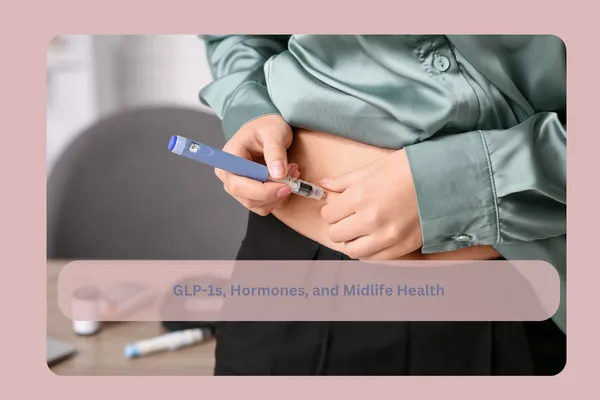
GLP-1s, Hormones, and Midlife Health
Just like with the topic of perimenopause, You’ve probably noticed the shift, even if you haven’t fully put words to it yet. Conversations around medications like Zepbound and Wegovy are no longer just about weight, and they’re no longer whispered quietly behind closed doors. They’re showing up just like perimenopause in podcasts, interviews, and social media feeds, often led by women who look a lot like you, capable, high-achieving, and suddenly navigating changes in their body that don’t respond the way they used to. And what’s striking is not just the visibility, but the language that’s starting to change, because for the first time in a long time, women are saying out loud that this isn’t about willpower, and it isn’t about trying harder, it’s about biology.
GLP-1 medications are becoming part of the conversation around perimenopause and menopause because they support blood sugar regulation, metabolism, and brain clarity during a time when a woman’s physiology is naturally shifting. Rather than being a shortcut, they can be used as a supportive tool within a broader understanding of your body, helping you work with your biology instead of against it.
Key Takeaways
GLP-1 medications are shifting from a weight-loss conversation into a broader hormone and metabolic health conversation
Emerging research suggests these medications may support blood sugar regulation, inflammation, and brain clarity during perimenopause and menopause
The current cultural conversation is moving away from blame and toward understanding physiology
At the same time, there is valid concern about using medication without fully understanding the underlying systems
The most grounded approach is not “yes or no,” but learning how your body works so you can make informed, supported decisions
What You’re Seeing Right Now And Why It Feels So Confusing
There’s a reason this conversation feels layered, and it’s because two things are happening at the same time.
On one side, you’re seeing women, many of them in midlife, talk openly about using GLP-1 medications to navigate changes that felt out of their control, especially around weight shifts, energy, and mental clarity. These women are not describing themselves as lacking effort or commitment; in fact, many of them have spent decades being consistent with their health, and yet something changed.
On the other side, you’re also seeing a strong reaction against what people are calling “quick fix culture,” where the concern is that we are bypassing deeper understanding in favor of immediate results.
And you’re sitting in the middle of that, trying to make sense of what applies to you.
This is exactly where a more grounded conversation is needed, because neither extreme actually serves you.
What GLP-1 Medications Are Actually Doing in Your Body
Without getting overly technical, GLP-1 medications work with systems in your body that regulate blood sugar, appetite signaling, and how your brain perceives hunger and fullness. But what’s becoming more interesting, especially in the context of perimenopause and menopause, is how these systems intersect with your hormonal shifts.
During these years, your body is not just changing hormonally, it is also becoming more sensitive to stress, more variable in blood sugar regulation, and often less efficient in how it uses energy. This can show up as weight redistribution, increased cravings, disrupted focus, and that subtle but frustrating sense that your body is no longer responding to the same inputs.
What emerging research is beginning to explore is that GLP-1 medications may help stabilize some of these patterns by improving insulin sensitivity, reducing inflammation, and even influencing areas of the brain connected to focus and reward.
And that’s why women are starting to say, “This feels different than anything I’ve tried before.”
Not because it’s a shortcut, but because it’s interacting with physiology that hasn’t been fully addressed.
Why This Conversation Matters More Than the Medication Itself
Here’s where I want to gently shift your perspective, because the medication itself is not the most important part of this conversation.
The most important part is what this moment is revealing.
For years, women have been navigating changes in their body and being told, directly or indirectly, that they just needed more consistency, more control, or more effort. And now we are watching a cultural correction where women are recognizing that their body was not the problem, it was the lack of understanding around what their body was actually doing.
That is a powerful shift.
And it’s one you don’t want to miss by reducing this conversation to whether or not you “should” use a medication.
The Tension: Support or Substitution
At the same time, there is a real and valid tension here, and it deserves to be named clearly.
When a medication begins to work, especially in a way that feels relieving, it can be tempting to let it carry the entire load. But your body is still a system, and that system still requires nourishment, movement, recovery, and regulation in order to function well long term.
So the question is not whether GLP-1 medications are good or bad.
The question is whether they are being used as support within a larger understanding of your body, or as a substitute for that understanding.
Because if we try to medicate a system we don’t fully understand, we risk missing what your body has been trying to communicate all along.
What a More Grounded Approach Looks Like for You
A more grounded approach brings you back into partnership with your body instead of placing you at the mercy of trends or opinions.
It sounds like asking:
What is my body currently asking for that I may not have been taught to recognize?
Where have I been relying on effort instead of understanding?
What patterns am I noticing in my energy, focus, hunger, and recovery?
And if medication becomes part of your path, it is integrated into that awareness, not replacing it.
Because your goal is not just short-term change.
Your goal is internal reliability, where your body begins to feel more predictable, more supported, and more aligned with the life you’re leading.
The Bigger Conversation We Need to Keep Having
This is not just about GLP-1 medications.
This is about a larger shift in how women relate to their health.
It is about moving from self-blame to self-leadership.
From trying to override your body to learning how to work with it.
From chasing outcomes to understanding the patterns that create those outcomes.
And in that sense, this moment we’re in is actually a doorway.
A doorway into deeper awareness, better support, and a more honest conversation about what your body needs in this season of your life.
Conclusion
You don’t have to rush to a decision, and you don’t have to adopt someone else’s stance in order to move forward. What you do need is a clearer understanding of your own body, because that is what allows you to navigate options like GLP-1 medications with confidence instead of confusion.
And if there is one thing I want you to take with you from this conversation, it’s this:
Your body is not a problem to solve, it is a system to understand.
And the more you understand it, the more empowered every decision becomes.
