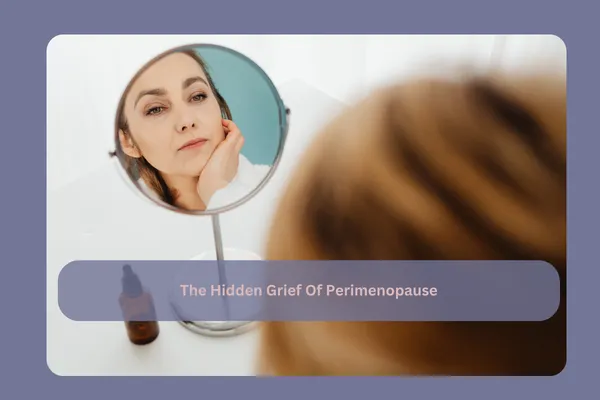
The Hidden Grief of Perimenopause
Perimenopause is not just a hormonal transition. For many women, it becomes an emotional experience of feeling unfamiliar to themselves. As estrogen, progesterone, cortisol, and nervous system patterns shift, women often grieve the loss of predictability, resilience, confidence, and ease they once carried naturally. This episode explores the hidden grief of midlife hormonal change, the connection between hormones and anxiety or emotional overwhelm, and how women can begin rebuilding self-trust through physiology, grace, and self-awareness rather than pressure and self-criticism.
Key Takeaways
Sometimes what women call “burnout” is actually grief over feeling disconnected from themselves for too long.
Perimenopause is not only a hormonal transition. It is often an identity transition.
Declining estrogen and progesterone can affect mood, anxiety, confidence, stress tolerance, sleep, memory, and emotional resilience.
Many high-achieving women quietly grieve the loss of predictability in their bodies while continuing to function outwardly.
The emotional experience of becoming unfamiliar to yourself is one of the least discussed realities of midlife women’s health.
Self-trust can be rebuilt, but it often requires learning to relate to yourself through a new lens of grace, physiology, and body awareness rather than pressure and self-criticism.
A well body in this season is not built through forcing. It is built through partnership with your changing physiology.
There is a kind of grief many women experience in perimenopause that almost nobody is talking about openly. Not because it is rare. But because most women do not even realize that grief is what they are feeling. Instead they think they are tired. Too emotional. Too sensitive. Too anxious. Too overwhelmed. Too forgetful. Too irritable.
Or maybe they, like you, tell themselves they are simply “getting older” and need to try harder to keep up.
But underneath all of that is often something much deeper.
They are grieving the version of themselves they used to know how to be.
And perhaps one of the hardest parts is that they are still functioning while it is happening.
They are still showing up to work. Still caring for children, aging parents, businesses, marriages, teams, responsibilities, households, and everyone else’s needs. Still answering texts. Still making appointments. Still getting things done.
Which means the world around them often has no idea how internally disoriented they feel.
And honestly, I think this is one of the most emotionally complex parts of perimenopause.
Because this season is not just about hot flashes and irregular periods.
It is about looking in the mirror one day and quietly wondering:
“Why do I not feel like myself anymore?”
The Emotional Experience Nobody Prepared Women For
There is a lot of conversation online right now around “perimenopause rage,” anxiety, mood swings, emotional instability, irritability, and overwhelm.
And yes, those things are real.
But what I do not think we are talking about enough is the emotional experience of becoming unfamiliar to yourself.
The woman who used to recover quickly suddenly feels depleted for days after stress.
The woman who used to carry enormous pressure effortlessly suddenly feels emotionally overloaded by things she once handled with ease.
The woman who used to trust her memory, focus, and decision-making suddenly starts second-guessing herself.
And because high-achieving women are so incredibly capable, they often compensate for these changes quietly for years before they ever acknowledge what is happening in the inside. They over prepare. Overwork. Over-function. Push harder. Become even more efficient.
But internally, many are carrying a growing fear that they are losing parts of themselves they used to rely on naturally.
That is grief, and it may not be grief from a death or some traumatic episode, but it is grief nonetheless. It is not weakness. Not failure. Not “being dramatic.”
What Hormones Have To Do With Anxiety, Mood, and Identity
One of the things I wish more women understood is that hormones influence far more than reproduction.
Estrogen, progesterone, cortisol, insulin, thyroid hormones, and neurotransmitters are deeply interconnected systems.
As estrogen begins fluctuating and declining during perimenopause, many women experience increased nervous system sensitivity. Estrogen affects serotonin, dopamine, and GABA pathways, which all play roles in mood regulation, emotional resilience, stress response, sleep, and anxiety levels.
Progesterone also has calming, protective effects on the nervous system, and as progesterone declines or becomes more erratic, women may notice feeling more emotionally reactive, anxious, restless, wired, or overstimulated.
This is one reason why women often say things like:
“I don’t feel emotionally steady anymore.”
“I don’t feel resilient like I used to.”
“I feel like everything suddenly feels harder.”
And when this is happening inside a life that is already carrying enormous pressure, caregiving, leadership demands, financial stress, relationship strain, constant decision-making, and emotional labor, it can begin to create a profound sense of internal unfamiliarity.
You begin wondering:
“Who even am I right now?”
And I think women deserve to hear this clearly:
Your body changing does not mean you are broken.
But it may mean the way you have been operating is no longer sustainable for the physiology you are living in now.
Sometimes What We Call Burnout Is Actually Grief
I keep coming back to this thought lately:
Sometimes what women call burnout is actually grief over living disconnected from themselves for too long.
Not just physically disconnected.
Emotionally disconnected.
Spiritually disconnected.
Physiologically disconnected.
Many women have spent decades overriding themselves in order to survive and succeed.
Ignoring exhaustion.
Ignoring stress.
Ignoring hormonal shifts.
Ignoring emotional needs.
Ignoring recovery.
Ignoring nourishment.
Ignoring rest because everyone else needed them.
And eventually there comes a moment where the body begins asking for a different relationship.
Not punishment.
Not shame.
Not another rigid system.
A different relationship.
One rooted in awareness.
Partnership.
Compassion.
Self-leadership.
Body stewardship.
I think this is especially difficult for high-achieving women because so much of their identity has been built around reliability, capability, performance, and productivity.
So when the body changes, it can feel deeply destabilizing emotionally.
Not because she is weak.
But because the systems she built her identity around no longer work the same way.
My Own Experience With This
I want to make this personal for a moment because I never want women listening to me to feel like I am speaking from some perfect mountaintop.
I understand what it feels like to become overridden.
I understand what it feels like to push through stress, caregiving, responsibility, work, leadership, and life while convincing yourself you are “fine” because you are still functioning.
There have absolutely been seasons where I have looked at myself and thought:
Why does everything feel harder than it used to?
Why do I feel emotionally stretched thinner?
Why am I questioning myself more?
And I think one of the hardest parts for women like us is that everyone else still comes to us for answers, because we are the capable one. The dependable one. The strong one. The helper. The leader.
So, when we privately start feeling disconnected from ourselves, it can create a quiet identity crisis nobody sees.
There were moments where I realized I had become so externally responsible that I had stopped truly listening inwardly.
And learning to reconnect with myself again did not happen through force.
It happened through awareness. Through slowing down enough to notice patterns. Through understanding physiology differently. Through recognizing that my body was not betraying me, but that she was communicating with me.
And honestly, there is still grace involved in this process every single day.
Even Public Conversations Around Midlife Are Beginning To Shift
We are finally starting to see more women publicly discuss the emotional and psychological realities of midlife hormonal change.
Women like Oprah Winfrey, Maria Shriver, and Naomi Watts have spoken openly about the emotional confusion, anxiety, identity shifts, and unexpected emotional changes that can happen during this season of life.
What I appreciate is that the conversation is slowly moving beyond simply “managing symptoms.”
Because women do not just need symptom management.
They need understanding.
They need context.
They need someone to explain that what they are feeling is not random.
And they need permission to stop interpreting every physiological shift as a personal failure.
The Mirror Changes Too
I also think we need to talk honestly about the emotional experience of looking in the mirror during this season.
Because body composition changes.
Skin changes.
Energy changes.
Recovery changes.
Sleep changes.
Facial changes.
Hair changes.
And for many women, there is grief attached to that too. Not because women are shallow. But because our physical identity is tied to familiarity.
There is something emotionally unsettling about feeling unfamiliar inside your own body.
Especially in a culture that often celebrates women for youth, output, perfection, and endless productivity.
This is why I believe women in this season need a radically different kind of support.
Not messaging that tells them to “fight aging.”
Not messaging that shames them into optimization.
But messaging that teaches them how to meet themselves with grace while still caring deeply for their health.
What Does It Look Like To Love Yourself Through Physiological Change?
I think this is where the conversation becomes deeply important.
Because if we are not careful, women will spend this season at war with themselves.
Trying to “fix” themselves back into a former version of who they were.
But perhaps the invitation here is not to become your old self again.
Perhaps the invitation is to build a new relationship with yourself entirely.
One based on:
Listening instead of overriding.
Supporting instead of punishing.
Working with your physiology instead of against it.
Understanding your nervous system instead of criticizing it.
Honoring your need for recovery instead of seeing it as weakness.
Creating a life that supports the woman you are becoming now.
Not the woman you had to be to survive previous seasons.
That is not giving up. That is wisdom.
Something Tangible To Walk Away With
So, if you are listening to this today and quietly recognizing yourself in this conversation, I want to give you something practical.
Instead of asking yourself:
“How do I get back to who I used to be?”
Try asking:
“What does the version of me I am becoming need from me now?”
Like I always say if we ask better questions we get better answers and results and The above question changes everything.
Because it shifts the conversation away from self-rejection and toward self-partnership.
And then I want you to begin gently noticing patterns without judgment.
Notice:
What drains you faster now.
What restores you now.
What environments dysregulate your nervous system.
What pace actually feels sustainable.
What foods, sleep habits, stressors, and relationships affect your body differently now.
What parts of yourself you may have ignored for years while trying to keep up.
This is not about becoming less powerful. It is about becoming more internally connected.
And honestly, I think that may be one of the deepest forms of leadership there is.
Wrapping it all up
Perimenopause is not simply a hormonal transition.
For many women, it is an emotional reckoning. A physiological awakening.
An invitation to rebuild trust with themselves after years of disconnection.
And while that process can absolutely carry grief, it can also carry profound wisdom, softness, clarity, self-respect, and deeper alignment.
You are not weak because your body is changing. You are human.
And maybe this season is not asking you to become smaller, tougher, or more disconnected from yourself.
Maybe it is asking you to finally come home to yourself in a completely different way.
