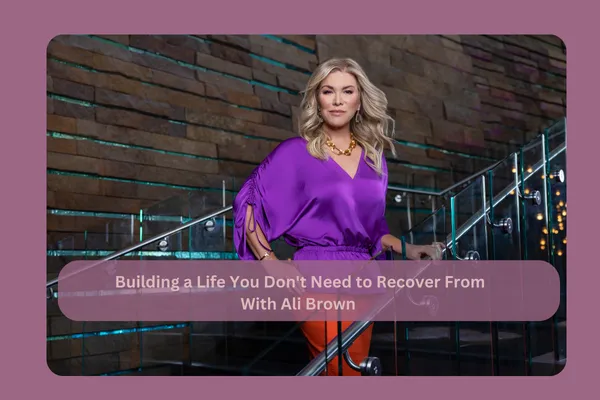
Building a Life You Don't Need to Recover From With Ali Brown
This is a transcribe version of the podcast. If you want to hear the entire interview listen to the podcast episode itself.
What if success isn't about doing more, but about creating a life that feels good to live? In this conversation, Ali Brown shares her perspective on ambition, wellness, hormones, faith, and the courage to redefine success in a way that supports both your life and your health.
Michele Broad:
I’m so honored to have you here because I’ve been in your universe for a very long time. I’ve always loved that you’ve been such an outside-the-box thinker, especially for women in business. I remember way back in the early days when you were doing the big events and workshops. I bought your programs, attended your trainings, and watched your evolution over the years.
One of the things I’ve admired most is watching you transition from those huge business-building years into what feels like a deeper alignment with who you truly are. You’ve spoken openly about letting things go, even when they were successful, and I think so many women struggle with that because when something is working, there’s this fear that if you release it, everything will fall apart.
I’d love for you to share more about that journey.
Ali Brown:
Well, first of all, thank you. It’s funny because when you mentioned CDs, I thought, “Wow, I really am an OG in this space.”
I came online during such an exciting time. My last traditional job was in New York City working at an advertising agency as a copywriter. Back then, the internet was just becoming mainstream. If you walked into a room and said you knew how to write copy for websites, people thought you were a genius because nobody really knew what they were doing yet.
I started freelancing because I realized I could make a good living without working for someone else. What was beautiful about that era was there was no social media, so I had nobody to compare myself to. I simply started teaching what I was learning.
People began asking:
“How are you getting clients?”
“How are you publishing newsletters?”
“How are you doing this online?”
So I wrote an ebook about writing and selling ebooks. Looking back now, it seems simple, but at the time it felt revolutionary.
That grew into coaching, workshops, seminars, and eventually large-scale events. The business became huge. Honestly, it became a train I almost couldn’t stop.
The interesting thing is that I was reaching goals and checking off all the boxes I thought I wanted. I wanted the big business, the team, the impact, the recognition. But eventually I realized it wasn’t sustainable.
Michele Broad:
I think so many women start businesses because they want freedom and meaning. They want to contribute financially, but they also want a life that feels aligned with who they are.
But then sometimes the business completely takes over their life.
Ali Brown:
Exactly.
At one point, I realized I couldn’t keep performing at that pace. I couldn’t keep being the person constantly at the front of the room trying to hold everyone’s attention and keep everything moving.
And I think there’s a huge awakening happening right now, especially for women. We’re questioning things differently.
What actually matters?
What kind of life do I want?
What am I willing to do?
What am I no longer willing to do?
That’s the real conversation.
Michele Broad:
I see this constantly in the women I care for medically too. Women adapt to pressure for years. They just keep functioning. They keep taking care of everyone else.
And sometimes they don’t even realize the load they’re carrying because it has become their normal operating system.
Ali Brown:
Yes. And I think many women, especially Gen X women, were taught to just keep going.
I remember going to my doctor years ago because I felt terrible. She asked me to rate my stress level from 1–10 and I said maybe a six.
She looked at me and said:
“No, Ali. You are carrying an intense amount of stress.”
But because that level of pressure had become normal to me, I couldn’t even recognize it anymore.
At the time I was navigating young children, divorce, supporting my mother, running a company, being the breadwinner — all at once.
And women do this every day.
Michele Broad:
That’s why I talk so much about women understanding their physiology and hormones. So many women are experiencing brain fog, exhaustion, anxiety, mood changes, and they think they’re failing somehow.
But biologically their bodies are changing.
Their hormones are changing.
Their nervous systems are overloaded.
Their environments no longer support the way their bodies function.
And nobody taught women how to work with those changes.
Ali Brown:
I’m actually a huge fan of HRT and getting support during this phase of life. I work with an incredible doctor and it changed everything for me.
Women need to understand that these biological shifts are real. We’re not imagining this.
And we also live in systems that were not designed around women’s cyclical physiology.
We’re expected to perform the same way every day no matter what our bodies are doing.
Michele Broad:
Exactly.
There are days women need more rest, more recovery, more gentleness — but our culture doesn’t make space for that.
So women keep pushing through while their biology is asking for something different.
Ali Brown:
One of the biggest changes I’ve made is designing my life differently.
I used to build my week around work.
Now I build my week around my life.
I intentionally schedule things that bring me joy:
hiking
movement
figure skating
time for myself
pleasure
recovery
And then work fits around that.
That shift changed everything.
Michele Broad:
I love that because I think women often feel guilty for prioritizing themselves.
But health is not just physical.
Heart health is emotional.
It’s relational.
It’s environmental.
It’s spiritual.
Women’s environments deeply shape their biology.
Ali Brown:
Absolutely.
And I think spirituality is becoming a much bigger part of the conversation now too. The women I’ve coached who seem the happiest and most grounded almost always have some kind of spiritual foundation or faith.
Especially after everything the world has experienced since 2020, people are asking deeper questions now:
Why am I here?
What matters?
What is true?
How do I want to live?
You need something to ground yourself.
Michele Broad:
I agree completely.
I think many women are waking up and realizing they don’t want to keep living disconnected from themselves anymore.
Ali Brown:
And that leads into ambition too.
Women need to redefine their metrics for success.
At one point, my success metrics were:
revenue
audience size
big events
visibility
Now my metric is:
time freedom.
How much space do I have to actually enjoy my life?
That’s success to me now.
Michele Broad:
I think women need permission to understand that success can look different.
It doesn’t have to mean running yourself into the ground.
Ali Brown:
Exactly.
There are many ways to build a beautiful business and a meaningful life.
Don’t let anyone convince you there’s only one path.
Michele Broad:
That is such an important message, especially in today’s online world where everyone is telling women there’s one formula for success.
Ali Brown:
And social media amplifies that pressure.
Women are constantly comparing themselves, chasing numbers, trying to fit into formulas that may not even align with who they are.
You have to stay rooted in your truth.
Michele Broad:
Absolutely.
Well, thank you so much for being here today. This conversation was incredible and I know women are going to take so much from it.
Ali Brown:
Thank you, my friend. I’ve been honored to be here.
