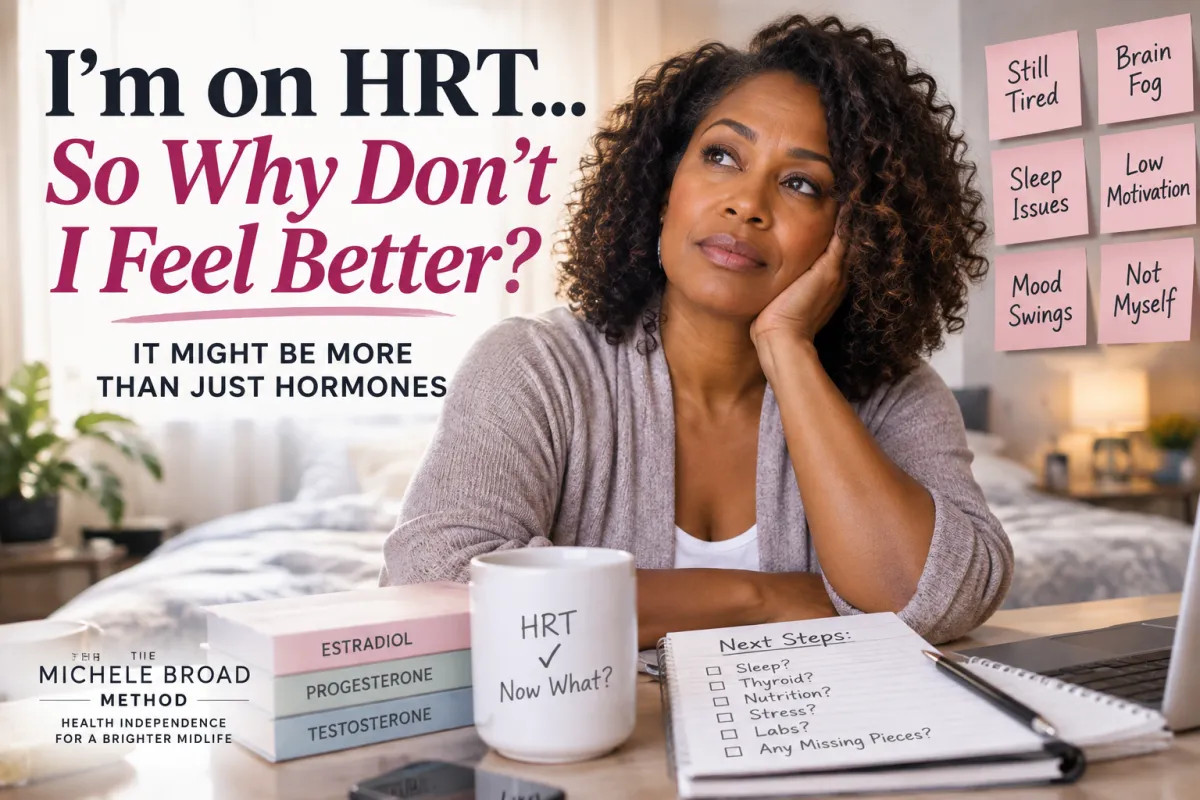
I’m on HRT… So Why Don’t I Feel Better?
If you've been thinking, “I know something has changed in my body, I just don't understand what,” I created something for you.
It's called Feel Like Yourself Again, and it's a free five-day experience designed to help you understand what may be behind the changes you've been noticing, from your sleep and energy to your hormones, stress, brain fog, and that general feeling that something is just...off.
Because here's what I want you to know: your symptoms aren't random, and your hormones don't live in a vacuum. There is a bigger story happening in your body, and once you begin to understand that story, you can stop guessing about what you need and start asking better questions about your health.
It's completely free, and you can go through it on your own time.
Go to MicheleBroad.com/Feel-Like-Yourself-Again to get started.
All right, let's get into today's conversation.
Conversation Takeaways
If you’re already on HRT and still don’t feel like yourself, it doesn’t automatically mean your hormone therapy isn’t working. Pay attention to what improved and what didn’t, because those differences are useful information.
Hormones are an important part of your midlife biology, but your hormones don’t live in a vacuum. Sleep, stress, thyroid function, metabolic health, nutrition, muscle, recovery and what is happening in your everyday life can all be part of the larger picture.
Sometimes hormone therapy needs to be reassessed or adjusted. Other times, a persistent symptom may be asking us to look beyond hormones instead of continuing to turn the same dial.
You don’t have to choose between HRT and supporting the rest of your health. Good midlife care should allow those things to exist in the same conversation.
And perhaps most importantly, if you still don’t feel well, the next question may not be, “Why isn’t my HRT fixing me?” It may be, “What part of my story haven’t we looked at yet?”
“But I’m Already on HRT”
There is a conversation I find myself having with women in my everyday practice more and more often. A woman comes in, we start talking about what has been going on with her, and somewhere in the conversation she tells me, “Well, I’m already on HRT.”
She has the estrogen patch. She takes the progesterone. Maybe the dose has already been changed once or twice, and some things may actually be better. Her hot flashes aren’t as bad. Maybe she’s sleeping a little better. Maybe the night sweats have finally stopped requiring a complete pajama change at 2:17 in the morning. Then she looks at me and says something I hear all the time: “But I still don’t feel like myself.”
That sentence matters because I think many women have unintentionally been given the impression that there are two versions of midlife. There is the miserable woman whose hormones are declining, and then there is the happy woman who finally gets her HRT. Patch applied, progesterone swallowed, cue the birds singing, and somewhere in the distance the old you comes running back through a field of wildflowers.
Except women’s bodies don’t actually work that way.
Before somebody thinks I’m about to give you an anti-HRT lecture, let me clear that up right now. I prescribe hormone therapy. I believe hormone therapy can be incredibly helpful for the right woman, at the right time, for the right symptoms. We have very good evidence that systemic hormone therapy is the most effective treatment for hot flashes and night sweats, and it can help with other menopause related symptoms and has important benefits for bone health as well.
But HRT is a treatment. It isn’t a magic eraser, and I think understanding that distinction can save women an enormous amount of frustration.
When HRT Helps...But You Still Feel Off
What I often hear in practice isn’t that hormone therapy has done nothing. The conversation is usually much more nuanced than that. A woman will tell me her hot flashes are better, but she is still exhausted. Her sleep improved, but she still wakes up some nights and cannot get back to sleep. Her mood is better, but she still has no energy. Her estrogen has been increased, but the brain fog hasn’t gone anywhere. Or she simply says, “I thought I would feel more like myself by now.”
Interestingly, when I went looking at what women were saying outside the exam room, I found the same conversation happening online. Women describe starting estrogen and progesterone and seeing meaningful improvement in things like hot flashes, anxiety, sleep or brain fog, while still struggling with significant fatigue or that lingering sense that they just don’t feel right. Others describe months or even years of adjusting doses and still asking some version of the same question: What am I missing?
And that is the question I want us to talk about, because I think it is a much more useful question than immediately assuming, “I must need more estrogen.”
Sometimes you might. Sometimes your hormone therapy does need to be adjusted. Dose matters. Route matters. Timing matters. Your symptoms, medical history and individual response matter, and finding the appropriate hormone regimen can take some trial and adjustment. But sometimes we keep turning the hormone dial simply because it is the dial we can see, when what we really need to do is backup and widen the lens.
Your Hormones Don’t Live in a Vacuum
One of the most important things I teach women is that your hormones don’t live in a vacuum. When we prescribe estrogen, it doesn’t arrive in some pristine little hormonal laboratory where estrogen, progesterone and testosterone are sitting around waiting for it.
Estrogen enters the body you are already living in.
Think about that for a minute.
It enters the body that may have been sleeping five or six fragmented hours a night for the past three years. It enters the body that has been running from meeting to meeting, raising children, managing employees, building a business, caring for aging parents and answering emails while standing at the kitchen counter eating something that technically qualifies as lunch. It enters a body that may be having heavy periods and losing iron, a body whose thyroid deserves another look, a body that has lost muscle over the years or is experiencing changes in insulin sensitivity and blood-sugar regulation. It enters a nervous system that may have spent years operating under chronic pressure with very little true recovery.
It enters your body, carrying your life.
Then sometimes we put estrogen on that body and expect it to fix every symptom the body is producing.
That is a pretty big job for a little patch.
What Improved and What Didn’t?
This is why I want women to understand the difference between saying, “HRT isn’t working,” and saying, “HRT helped some things, but I still don’t feel well.” Those are not necessarily the same statement.
Fatigue is a perfect example. A woman in midlife can absolutely experience fatigue alongside perimenopause and menopause, and hormonal changes may be part of that picture. But fatigue can also be influenced by fragmented sleep, iron deficiency from heavy bleeding, thyroid problems, sleep apnea, depression or anxiety, metabolic changes, inadequate nutrition, chronic stress and simply not having enough opportunity to recover from the demands being placed on the body.
So imagine a woman whose night sweats improve beautifully after starting HRT, but she still wakes up every morning feeling as if someone unplugged her overnight. If we decide that every bit of her fatigue must still be an estrogen problem, we may miss the next question we should be asking. How is she actually sleeping? Is she snoring now? What are her periods doing? What does her stress load look like? Has her thyroid been appropriately evaluated? What is happening with her nutrition, blood sugar, movement and muscle? Does her body ever get a real recovery signal?
None of those questions minimize the role of hormones. They are part of practicing good women’s health.
We Needed a Better Menopause Conversation, But Not a One-Answer Conversation
I think this is especially important because women have been underserved in menopause care for a very long time. Women have been told their labs were normal, that they were too young to be experiencing perimenopause, that their symptoms were simply part of getting older or that they should learn to live with them. Some have been offered an antidepressant without much discussion about what else could be happening. Many women have had to fight just to get someone to take their symptoms seriously.
We needed to correct that, and I am glad the conversation around menopause and hormone therapy has changed.
But I also don’t want us to swing so far in the other direction that every symptom experienced by a woman in her forties or fifties becomes an estrogen deficiency until proven otherwise. We can acknowledge how important hormones are without asking them to take responsibility for every single thing happening in a midlife woman’s body.
There is a much richer conversation available to us.
Your hormones matter, and so does your sleep. Your stress physiology matters, and so does your metabolic health. Your thyroid, muscle, nutrition and ability to recover matter. The responsibilities you carry, the pace at which you live, the amount of rest your body receives and the years you may have spent pushing through matter too. Your life and your biology are having a conversation with each other all day long, and I don’t think we serve women well when we listen to only one side of it.
No, You Do Not Need Another Full-Time Job Called “Wellness”
Now, whenever I start talking about the whole picture, I can almost hear a woman thinking, “Michele, please do not give me seventeen more things I need to do. I am already exhausted.”
I agree.
The last thing an overwhelmed woman needs is for someone to turn feeling better into another full-time job. Sometimes wellness advice becomes almost comical. A woman tells us she is exhausted, overwhelmed and barely keeping all the plates spinning, and we respond by giving her a morning routine requiring supplements, meditation, journaling, meal prep, strength training, breathwork and perhaps grinding her own flaxseed before 7 a.m.
Ma’am, she said she was tired.
She does not need another part-time job called Wellness.
What she needs first is understanding.
If you are on HRT and still don’t feel well, I don’t want you to assume that you failed hormone therapy, and I certainly don’t want you to assume your body is failing you. I want you to become curious about what changed and what didn’t. Maybe the hot flashes disappeared but the fatigue stayed. Maybe your sleep improved but your afternoon crash didn’t. Maybe your mood is better but your brain still feels foggy. Maybe several symptoms improved and one stubborn symptom never moved at all.
That information matters because it begins to separate one giant, frustrating statement “I still don’t feel like myself” into pieces that we can actually understand.
Before we keep going, if you're listening to this conversation and thinking, “Okay Michele, but how do I figure out what is actually happening in my body?”—that's exactly why I created Feel Like Yourself Again.
It's my free five-day experience where I'll help you start connecting the dots between your symptoms, your changing hormones, your stress, your sleep, and the life your body is actually living.
I'm not going to give you another giant wellness checklist. I'm going to teach you how to start reading your own body's story, so you have a better idea of what deserves your attention and better questions to take into your healthcare conversations.
You can join me for free at MicheleBroad.com/Feel-Like-Yourself-Again.
Okay, back to our conversation.
It Isn’t HRT or Lifestyle
This is also why I don’t believe women should have to choose between hormone therapy and supporting the rest of their biology. It isn’t HRT or lifestyle. It isn’t estrogen or sleep. It isn’t progesterone or stress management. It isn’t medical treatment or understanding your body. These things belong in the same conversation.
For some women, getting the hormone piece right changes their lives. For another woman, HRT improves three major symptoms, but the fourth symptom requires us to look somewhere else. For another, the hormone regimen itself needs to be reassessed with her healthcare provider. And for another woman, addressing sleep apnea, iron deficiency, thyroid dysfunction, metabolic health, nutrition, muscle loss or chronic stress becomes another important piece of the puzzle.
There isn’t one universal midlife prescription because there isn’t one universal midlife woman.
Maybe We Need to Ask a Different Question
So when a woman sits across from me and says, “But I’m already on HRT. Why don’t I feel better?” my response isn’t automatically, “HRT isn’t working.” It also isn’t, “Well, you need to exercise more, eat better and manage your stress,” because that is rarely helpful and often just makes an already overwhelmed woman feel as though she has been handed another list of things she is doing wrong.
Instead, I want to know what the hormones helped, what they didn’t help and what the rest of her body may still be trying to tell us.
Because maybe the better question isn’t, “Why isn’t my HRT fixing me?”
Maybe the better question is, “What part of my story haven’t we looked at yet?”
That question changes the conversation. Instead of endlessly chasing the next isolated solution, you begin learning how the pieces of your biology connect. You start recognizing patterns. You learn which symptoms deserve another conversation with your healthcare provider and which parts of your everyday life may be influencing what you are experiencing.
This Is What I Mean by Health Independence
That is what I mean when I talk about Health Independence. It doesn’t mean knowing everything about medicine. It doesn’t mean diagnosing yourself, refusing medication or becoming your own hormone prescriber after three TikToks and a podcast. It means understanding your body well enough to recognize patterns, ask better questions, participate meaningfully in your healthcare decisions and know when something deserves a closer look.
Because ultimately, the goal was never simply to get you on hormones.
The goal is to help you feel well and understand enough about your body to know why.
