Perimenopause Symptoms...Normal Labs?
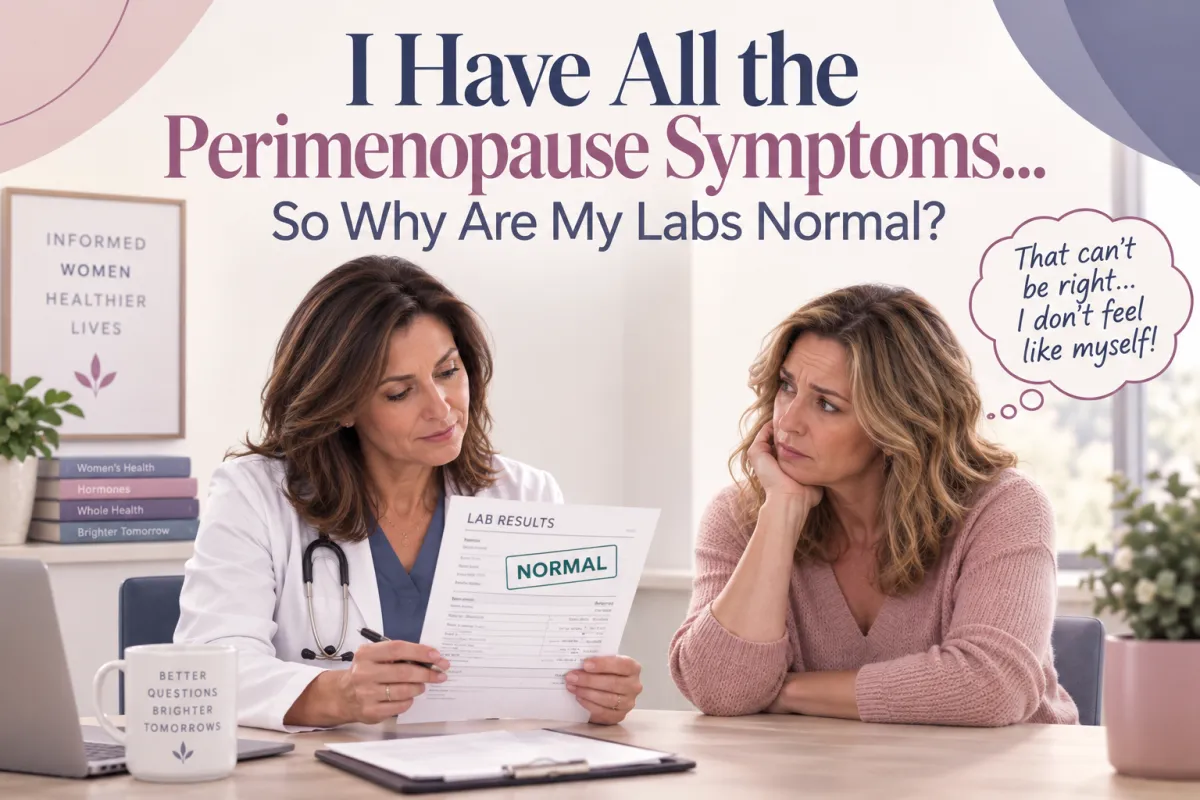
I Have All the Perimenopause Symptoms… So Why Are My Labs Normal?
There may be few things more confusing in women's health than knowing something has changed in your body, finally deciding to ask someone about it, having blood drawn and then hearing the words, “Good news. Everything looks normal.” On the one hand, of course you want your test results to be normal, but on the other hand you're sitting there thinking, That's wonderful. Should I tell my body? Because apparently she missed the memo. You're still not sleeping the way you used to, your periods have changed, you're hot when everyone else in the room seems perfectly comfortable, your brain occasionally forgets words you've been using since third grade, your energy isn't what it used to be and perhaps your mood, libido or ability to tolerate the people you actually love has changed a little too.
This is something I hear from women all the time, and I think it's become even more confusing because women are hearing so much about perimenopause and hormones right now. They recognize themselves in a list of symptoms, start wondering whether perimenopause could explain what they're experiencing and understandably want something concrete that will tell them whether they're right. So they ask for hormone testing, the results come back sitting nicely inside the laboratory's reference range and suddenly they're left wondering whether that means they aren't in perimenopause after all—or worse, whether they've somehow imagined what they're experiencing.
They haven't. But a normal hormone result doesn't automatically prove that perimenopause is causing those symptoms either, which is why this conversation requires a little more curiosity than simply normal or abnormal. Once we understand what hormone testing can tell us, what it sometimes can't tell us and what other information belongs in the conversation, we can start asking much better questions about what is actually happening in your body.
What You'll Take Away From This Conversation
By the time we're finished, I want you to understand why one “normal” hormone test doesn't necessarily rule out perimenopause, why hormone levels during this transition don't always behave in a nice predictable straight line, and why your symptoms, menstrual changes, age, health history and patterns over time matter alongside laboratory results. We'll also talk about why labs still have an important role, particularly when we're looking for other things that can mimic or contribute to midlife symptoms, and why understanding the bigger picture doesn't mean I'm against HRT. Quite the opposite: better understanding helps you make better treatment decisions. Most importantly, I want you to leave knowing what questions to ask if you've been told everything is normal while you still don't feel like yourself.
Perimenopause Isn't an On/Off Switch
I think one of the first things we need to clear up is the idea that one day you're not in perimenopause, the next day you are, and somewhere inside your body a little light turns on announcing PERIMENOPAUSE HAS OFFICIALLY BEGUN. Wouldn't that be convenient? Maybe our ovaries could send us a notification: Congratulations! Your menopausal transition has begun. Please allow several years for processing. At least then we'd all know what was happening.
Unfortunately, biology rarely gives us that kind of neat beginning. Perimenopause is a transition during which ovarian function and hormone patterns are changing, menstrual cycles may begin to change and symptoms such as hot flashes, night sweats and sleep disruption can appear. What makes the laboratory conversation particularly important is that these hormonal changes don't necessarily happen in a smooth, predictable decline. Your ovaries didn't receive an email saying, Beginning Monday, please reduce estrogen production by exactly 2% every week until further notice. Hormones can fluctuate during this transition, which means what we see on one particular day may not perfectly represent what has been happening over the previous weeks or months.
That is one reason I don't want a woman to look at a single estrogen or FSH result that falls within a reference range and conclude, “Well, I guess this can't be perimenopause.” Depending on her age and clinical situation, her menstrual history, symptoms and the way those symptoms have changed over time may tell us far more about where she is in the menopausal transition than repeatedly chasing a reproductive hormone number.
A Lab Is a Snapshot. Your Body Is a Movie.
One of my favorite ways to explain this is to imagine that I take a beautiful photograph of Colorado in July. The sky is blue, the trees are green, the sun is shining and maybe I'm standing outside in a short-sleeved shirt. Then I hand you that photograph and say, “See? Colorado is warm.” There is nothing inaccurate about the photograph because it captured what Colorado looked like at that particular moment, but I certainly wouldn't recommend packing for January based on it.
The photograph wasn't wrong; it was incomplete.
That's a useful way to think about a single hormone measurement during a biological transition in which hormones may be fluctuating. The blood test gives us real information about what was happening when the sample was collected, and there may be very good reasons to obtain that information, but it is still a snapshot. You are the movie. Your menstrual history is part of the movie, your symptoms are part of the movie, when those symptoms began is part of the movie, how they've changed is part of the movie, and your age, health history, medications and other possible contributors are part of the movie too.
When we take one frame from that film and expect it to explain the entire plot, we may be asking that one piece of information to do more than it can. That's particularly relevant because, in otherwise healthy women in the typical age range whose menstrual history and symptoms fit the menopausal transition, perimenopause is often identified clinically rather than by repeatedly measuring reproductive hormone levels.
That doesn't mean the laboratory has suddenly become irrelevant. It means we need to understand what question we're asking the laboratory to answer.
So Michele, Are You Saying Labs Don't Matter?
Absolutely not, and I want to make that very clear because women's health conversations have an annoying habit of swinging from one extreme to another. For years, many women felt that their symptoms weren't being taken seriously, and now sometimes we see the pendulum swing toward the idea that every midlife symptom must be hormonal and testing doesn't matter. I don't particularly like either extreme.
Labs can be incredibly useful when we're asking them the right questions. If a woman comes to me exhausted, foggy, struggling with sleep, experiencing menstrual changes and generally saying, “I just don't feel like myself,” I don't want to decide before I've even heard her story that estrogen explains everything. Maybe the menopausal transition is a significant part of what she's experiencing, but I also want to consider whether thyroid disease could be contributing, whether anemia or iron deficiency might be relevant—particularly if she's experiencing significant bleeding—whether metabolic issues deserve attention, whether a medication could be contributing, whether there's a sleep disorder hiding underneath all of this or whether something else entirely is going on.
There are also women whose age, symptoms, menstrual history or medical situation makes additional evaluation appropriate. So no, I'm not anti-lab. I'm anti-asking one laboratory value to tell us a story it can't possibly tell by itself. That's a very different position, and I think it's an important distinction.
We Need the Woman, Not Just the Number
This is where I think healthcare can sometimes get turned upside down. We have incredibly sophisticated laboratory testing, imaging, medications and technology available to us, and I'm grateful for all of it, but sometimes one of the most valuable diagnostic tools we still have is the conversation.
I want to know when this started and what changed first. I want to know what happened next, what your periods are doing, how you're sleeping, what your energy feels like, whether you're having hot flashes or night sweats, what has happened with your mood, what medications you're taking and what else is happening medically. And yes, I also want to know what is happening in your life, because the woman sitting in front of me doesn't stop being a human being simply because we've started talking about her hormones.
Maybe she's leading a company or building a business. Maybe she's raising teenagers or helping adult children launch into their own lives. Maybe she's caring for aging parents while trying to maintain a career and a marriage. Maybe she's an empty nester adjusting to an entirely different season of life, or maybe she's spent the last twenty years becoming extraordinarily good at pushing through exhaustion because there simply wasn't another option. None of that means her symptoms are “just stress,” and I really dislike when women are given that dismissive explanation. What it means is something much bigger: her biology is happening inside her life, and her life is happening inside her biology.
Those aren't competing stories. They're the same woman.
That's why, when we're trying to understand why she doesn't feel like herself, I want all of the information on the table. Her laboratory results are information, but so are her symptoms, menstrual patterns, medical history, medications, sleep, stress, nutrition, metabolic health and the demands her body is carrying every day. We aren't looking for one piece of information to win. We're trying to understand how the pieces fit together.
And What If I Already Know I Want HRT?
I know some of you are reading this thinking, Okay Michele, I understand the bigger picture, but I came here because I want to know whether I can take hormones.
Good. Then let's talk about HRT.
One thing I never want a woman to hear from me is that understanding her body means she has to earn her way to treatment by perfecting her lifestyle first. That isn't what I'm saying. Hormone therapy can be an appropriate and effective treatment for many women experiencing bothersome menopausal symptoms, depending on the individual woman's health history, risks, symptoms and goals. If you and your healthcare provider determine that HRT is appropriate for you, then understanding the rest of your health does not somehow make that treatment less legitimate.
Understanding and treatment are not opponents. Understanding helps us make better treatment decisions.
If the only question we're asking is, “Can I get estrogen?” we may simply be starting the conversation too far downstream. I'd rather understand what you're experiencing, what patterns are showing up, what else may be contributing, whether there's anything we shouldn't miss, what treatment options are available and which of those options makes sense for you.
And this matters even if you're already taking HRT. Maybe your hot flashes improved beautifully, but you're still exhausted. Maybe your sleep improved somewhat, but you still wake during the night. Maybe HRT helped several symptoms but not others. That doesn't mean you failed at menopause, and it doesn't automatically mean HRT “isn't working.” It means we keep asking questions. What improved? What didn't? What else is happening? Could sleep, thyroid, iron, metabolic health, medications, stress load, nutrition, movement or recovery be contributing to what's left?
Treatment enters a whole human being, which is why context still matters after treatment begins.
Here's the Plot Twist
The part I really want you to hear is this: the goal isn't to prove that your hormones are abnormal.
Sometimes women feel as though they need a laboratory result to give them permission to trust what they're experiencing. If the number is abnormal, they think, Aha! Now I have proof. If the number is normal, they begin wondering whether maybe this is all in their head. Neither conclusion gives us a particularly useful way to understand health.
The better question is, “What is happening to me?” That question leaves room for perimenopause, but it also leaves room for thyroid disease, iron deficiency, sleep problems, medication effects, metabolic health, stress physiology and the possibility—which happens more often than we sometimes acknowledge—that more than one thing can be true at the same time.
After thirty years of caring for women, I am far less interested in making a woman's symptoms fit neatly inside a diagnosis than I am in understanding the woman experiencing those symptoms. That shift may sound small, but it changes the entire conversation. Instead of starting with a label and trying to make her fit inside it, we start with her and work outward.
What I Want You to Do With This
If you've been told your hormone labs are normal but you still don't feel like yourself, I don't want you leaving that conversation believing there are only two possibilities: either your hormones are abnormal or nothing is wrong. There is a great deal of room between those two conclusions, and that's where good clinical conversations often live.
Remember that perimenopause is a transition rather than a single laboratory number, and that your menstrual changes, symptoms, age and overall clinical picture matter. Remember too that a normal test result doesn't necessarily mean, “We're done asking questions.” Sometimes a normal result is extremely useful because it helps us narrow the possibilities and decide what question should come next.
And when you go into your next healthcare conversation, you don't need 47 screenshots, a color-coded binder and a minor in endocrinology from Google University. Instead, go in with a few thoughtful questions. Ask whether your symptoms and menstrual changes could still be consistent with perimenopause despite a normal hormone result. Ask what else should be considered that might be contributing to what you're experiencing. And ask what treatment options make sense based on your symptoms, health history, risks and goals rather than simply one laboratory value.
Those questions move us away from “Tell me what's wrong with me” and toward “Help me understand what might be happening and what my options are.”
That's the kind of health independence I want for women. It doesn't mean becoming your own doctor, diagnosing yourself or being suspicious of every recommendation you're given. It means understanding enough about your own body to participate meaningfully in the conversation, notice patterns, ask better questions and make thoughtful decisions alongside the healthcare professionals you trust.
So if you're sitting there with a lab report that says normal while your body is telling you something has changed, don't panic, but don't throw the laboratory report away either. Put it on the table with the rest of the information and keep asking questions, because sometimes “normal” isn't the end of the conversation.
Sometimes it's simply one more piece of information helping us figure out what question to ask next.
Stop guessing. Start understanding.
That's where better health decisions begin.
