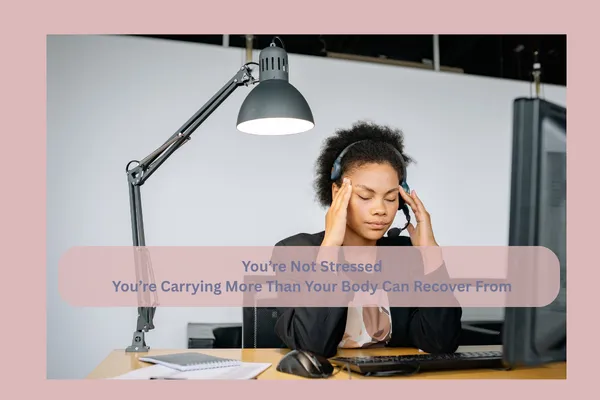
You’re Not Stressed... You’re Carrying More Than Your Body Can Recover From
There is a version of stress that doesn’t look like stress. It doesn’t look like panic or overwhelm or falling apart. It looks like you, still showing up. Still leading. Still getting things done.
And yet… something feels different. Your energy is inconsistent. Your focus takes more effort.
You feel a little less patient, a little less clear, a little less like yourself. And because nothing is “wrong enough,” you don’t call it anything. But your body is calling it something.
This Is Not Burnout…..This Is Physiological Drift
We have been taught to recognize stress only when it becomes obvious. When you can’t
function. When everything breaks down. But that is not how it starts.
For most high-achieving women, stress doesn’t arrive loudly. It accumulates quietly while life continues to move. You adapt. You adjust. You carry more. And because you are capable, you normalize it.
Until one day you realize:
Things that used to feel easy now take effort
Rest doesn’t feel restorative
Your capacity feels different
This is what I call: a chronic override state
What You’re Feeling (But Haven’t Named Yet)
Let’s put language to what you’re experiencing, because this is where the shift begins.
You might notice:
You’re tired… but not in a way sleep fixes
You’re functioning… but it takes more effort than it used to
Your patience is shorter, but you can still “hold it together”
You feel wired at night and slower in the morning
You’re doing all the right things… but not feeling the return
None of this feels dramatic. But it’s not random either. These are early signals your system has been under sustained load. And most women dismiss them, because they’re still performing.
What’s Actually Happening in Your Body
Here’s where we elevate the conversation, because your body does not experience stress the way your calendar does.
It experiences:
hormonal shifts
nervous system activation
energy redistribution
When stress becomes chronic:
cortisol stays elevated longer than it should
your body shifts into conservation mode
recovery becomes harder to access
cognitive functions like focus and decision-making decline
In fact, research shows that 75–90% of doctor visits are linked to stress-related conditions.
And for women specifically: stress impacts hormones like estrogen, it affects memory, mood, and concentration, it increases your risk for fatigue, sleep disruption, and emotional instability.
This is not just about “feeling stressed.” This is about how your body is being asked to operate under pressure.
Why Rest Isn’t Working Anymore
This is the part that confuses most high-achieving women, because they assume rest and recovery are the same thing, but they are not.
You’re resting, you're taking time off, trying to slow down, and going to bed earlier. And yet…you still feel tired and you still feel off.
Rest is a pause. Recovery is a physiological process.
If your system is still activated internally, you can be “resting” and still not restoring.
You Don’t Need Better Stress Management…. You Need Recovery
This is where the linear work model work disrupts the norm.
Most women are taught to:
manage stress
cope better
stay organized
push through
But stress management keeps you functional. It does not reduce the load. Recovery does.
Recovery is not about doing more.
It’s about:
lowering internal demand
reducing constant adaptation
creating space for your system to settle
How This Is Affecting Your Leadership (Even If You Haven’t Noticed)
This is the conversation I don’t see happening. Because you are still showing up, you assume your leadership is unaffected.
But subtle shifts are happening:
decision-making takes longer
your tolerance for pressure decreases
creativity feels harder to access
you rely more on effort than clarity
This is not a mindset problem. This is a physiology problem. And the longer it goes unaddressed, the more it becomes your baseline.
Quick Wins: How to Start Supporting Your System Today
Not overwhelming. Not another routine.
Just small shifts that signal safety and support.
1. Create “micro-recovery” moments during your day
Not just at night.
5 minutes of quiet without input
stepping outside without your phone
slowing your pace intentionally
Your nervous system needs repetition, not one long break.
2. Reduce input, not just output
Scrolling is not rest. Noise is not recovery.
Choose:
silence
stillness
lower stimulation
This helps your system actually settle.
3. Stop turning coping into performance
You don’t need to:
journal perfectly
meditate correctly
“optimize” your recovery
If it feels like effort, it’s not recovery.
4. Match your capacity, not just your responsibilities
This is leadership.
Not everything needs to be done at full intensity.
Ask:
“What can be softened today?”
5. Acknowledge what you’ve been carrying
This one is simple but powerful.
Say it out loud or write it down:
“I’ve been carrying more than I realized.”
That alone reduces internal pressure.
My friend, you are not behind. You are not unmotivated. You are not “just stressed.”
You have been operating in a chronic override state, without being taught how to come out of it.
If this is resonating with you, if you’re realizing that what you’ve been calling “normal”
might actually be your body asking for something different, then join me over on Instagram at www.instagram.com/michelebroadnp and in my weekly newsletter https://substack.com/@michelebnp
Because your physiology is not separate from your performance. It is the foundation of it.
