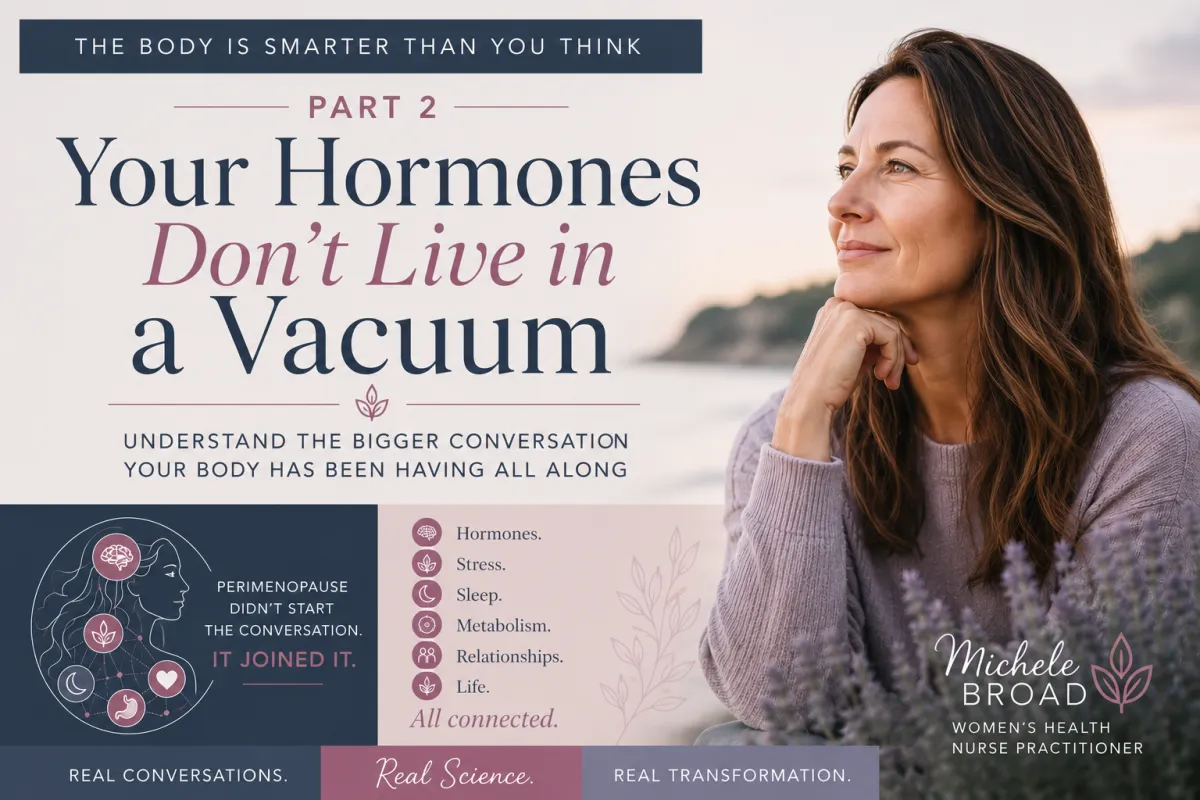
What if The Body Is Smarter Than You Think- Part 2
Before You Read
In this conversational essay you'll discover:
Your hormones don't work independently—they're part of a beautifully connected biological system that is constantly responding to your life.
Symptoms rarely tell the whole story. They make more sense when viewed in the context of your sleep, stress, nutrition, relationships, environment, and changing biology.
Perimenopause didn't begin the conversation. It joined a conversation your body has been having for years.
Understanding your body begins with asking better questions—not simply searching for a quick fix.
Health Independence starts when you stop seeing your body as the problem and begin understanding what it has been responding to.
What if your symptoms aren't the result of one hormone going wrong, but part of a much larger biological conversation? In Part Two of The Body Is Smarter Than You Think, we'll explore why hormones never work in isolation and how understanding the bigger picture can change the way you see your body. Discover why perimenopause doesn't begin the conversation, it joins one your biology has been having all along and how asking better questions is the first step toward lasting health and greater self-understanding.
There are moments in medicine that change you forever, although they rarely happen all at once. More often, they unfold quietly over years of listening, observing, and beginning to notice patterns that no textbook ever pointed out.
When I first became a women's health nurse practitioner, I believed my responsibility was to find answers. A woman would come into my office with a list of symptoms, and my job was to determine which hormone was out of balance, which lab needed to be ordered, or which treatment might help her feel better. There is certainly value in all of those things, and I still believe good medicine requires careful evaluation and thoughtful treatment.
But somewhere along the way, something changed.
The longer I cared for women, the less interested I became in asking, "Which hormone is causing this?" and the more interested I became in asking, "What has this woman's body been responding to?"
At first glance, those questions may sound almost identical. They are both attempts to understand why someone feels the way she does. Yet over the years, I've come to realize they lead us down two very different paths.
The first question assumes that somewhere inside the body there is a single problem waiting to be identified and corrected. The second begins with the assumption that the body is intelligent and that every symptom, every change, and every adaptation may be part of a much larger story.
That shift has changed the way I practice medicine, and perhaps more importantly, it has changed the way I see the women who sit across from me.
For many of them, the symptoms that bring them into my office seem to appear almost overnight. One day they're sleeping well, thinking clearly, and feeling like themselves, and the next they're struggling with brain fog, interrupted sleep, weight gain, anxiety, or an exhaustion that doesn't seem to improve no matter how much they rest. It's understandable that they want to know what happened.
Most women arrive expecting the answer to be a single hormone.
What I've learned is that the answer is almost always more interesting than that.
One of the things I genuinely appreciate about the conversations surrounding women's health today is that we are finally talking openly about perimenopause and menopause. For far too long, women experienced these transitions believing they simply had to endure them in silence or accept that feeling miserable was just another part of getting older. Today, those conversations are happening in doctor's offices, around dinner tables, on podcasts, and among friends, and I believe that is something worth celebrating.
At the same time, I've noticed another trend emerging.
Many women have become remarkably familiar with the language of hormones before they've ever been given the opportunity to understand the biology behind them.
We know the words estrogen, progesterone, cortisol, insulin resistance, and hormone replacement therapy. We hear them on social media, in podcasts, and in conversations with friends. Those words have become part of our everyday vocabulary.
Knowledge, however, isn't quite the same thing as understanding.
Sometimes I worry that we've become so focused on learning the names of individual hormones that we've unintentionally lost sight of the remarkable biological system they belong to. We begin to think of estrogen as though it has its own separate job, cortisol as though it works independently from everything else, or thyroid hormones as though they operate in an entirely different part of the story.
Our bodies simply don't work that way.
The human body isn't organized into isolated departments where each hormone clocks in, does its work, and goes home at the end of the day. Every system is constantly communicating with every other system, adjusting moment by moment to the information it receives.
The more I've studied women's health, the more convinced I've become that one of the greatest misunderstandings in modern health education isn't that we talk too much about hormones. It's that we often talk about them as though they exist in isolation.
They don't.
And once you begin seeing your biology differently, it's almost impossible to go back to the old way of thinking.
One of my favorite ways to explain this to women is to imagine walking into a room where twenty people are gathered around a large table. Someone begins sharing an idea, another person responds, someone across the room offers a different perspective, and before long everyone is participating in the same conversation. No one is speaking independently. Every comment influences what happens next.
That image, to me, is a far better picture of your biology than any diagram of individual hormones floating through the bloodstream.
Estrogen isn't quietly doing its own thing while cortisol waits patiently for its turn. Your thyroid isn't working separately from your brain, and your immune system isn't carrying on an entirely different conversation. Every one of these systems is listening, responding, adapting, and exchanging information with the others every moment of every day.
That's why I say so often that your hormones don't live in a vacuum.
It isn't simply a phrase I've come to like. It has become one of the most important ways I think about women's health because it reminds us that hormones are never acting alone. They are part of an extraordinary communication network that is constantly paying attention to what's happening both inside your body and in the life you're living.
When you begin looking at your biology through that lens, something remarkable happens.
You stop seeing symptoms as isolated problems that appeared out of nowhere, and you begin seeing them as part of a conversation your body has been having all along.
The Story Your Biology Has Been Reading
One of the things I find most fascinating about the human body is that it doesn't experience life in the neat little categories we create for ourselves.
We tend to separate our lives into compartments. We think about work, family, marriage, children, aging parents, exercise, nutrition, sleep, stress, and menopause as though each one occupies its own place on the calendar. We move from one responsibility to the next, believing we've left the last one behind as we begin the next.
Our biology doesn't experience life that way.
Your body simply gathers information.
It notices whether you've been sleeping well or waking at three o'clock every morning with your mind already racing. It notices the seasons when work required more of you than you thought you had to give. It notices the years you cared for children, the months you spent supporting aging parents, the relationships that filled your heart, and the ones that quietly drained it. It notices joy, grief, purpose, disappointment, movement, stillness, nourishment, and neglect.
Every experience becomes part of the environment your body is responding to.
Perhaps that's why I've become less interested in asking women which symptom appeared first and more interested in understanding the life that surrounded it.
Not because life explains everything, but because life always provides context.
When we take the time to understand that context, the body often begins to make much more sense.
One of the greatest misconceptions I see today is the belief that symptoms simply appear one morning because hormones changed overnight.
In reality, our bodies are adapting every single day.
Most of those adaptations happen so quietly that we never notice them. Your body adjusts to interrupted sleep long before you recognize you're exhausted. It compensates for chronic stress before you ever call yourself stressed. It finds remarkable ways to keep you moving through demanding seasons of life, often asking for very little in return until one day it can no longer compensate in quite the same way.
Then something shifts.
Sleep becomes lighter.
Your thoughts don't come as quickly as they once did.
The weight you've always managed suddenly becomes more difficult to lose.
Your patience feels shorter.
Your resilience doesn't seem to stretch quite as far.
It's understandable that many women look at that moment and conclude that perimenopause is where the story began.
But I don't believe that's what happened.
I believe that's when the conversation became impossible to ignore.
One of the most important ideas I hope you'll carry with you is this:
Perimenopause didn't begin the conversation. It joined a conversation your biology was already having.
That isn't meant to minimize the very real hormonal changes that occur during midlife. Those changes matter, and they deserve thoughtful attention. Estrogen and progesterone influence nearly every system in the body, and their decline can absolutely contribute to many of the symptoms women experience.
But those changes don't happen inside an empty body.
They happen inside a body with a history.
A body that has spent decades adapting to your unique life.
A body that remembers years of interrupted sleep, periods of overwhelming responsibility, seasons of deep joy, unexpected heartbreak, illness, recovery, celebration, disappointment, and growth.
Your hormones become part of that story.
They are rarely the entire story.
That perspective has changed not only the way I care for women, but also the way I care for myself.
Whenever I'm tempted to ask, "What's wrong with my body?" I try to replace that question with a different one.
"What has my body been trying to manage, and what might it need from me now?"
It's a gentler question.
It's also a far more hopeful one.
When women begin asking questions like these, something beautiful starts to happen.
The relationship they have with their bodies begins to change.
Instead of seeing every symptom as evidence that something is broken, they begin seeing symptoms as invitations to become more curious. They stop looking at their biology as an obstacle that must be overcome and begin recognizing it as an intelligent partner that has been working tirelessly on their behalf, even during seasons when it didn't feel that way.
I've watched this shift happen hundreds of times over the years.
The women who make the greatest progress aren't always the women with the perfect treatment plan or the most comprehensive lab work. More often, they're the women who begin approaching their bodies with curiosity instead of criticism. Understanding changes the questions they ask, and better questions almost always lead to better decisions.
That's why I believe understanding is one of the most powerful forms of medicine we can offer ourselves.
It doesn't replace good medical care, thoughtful treatment, or the appropriate use of hormone therapy when it's needed. It gives those things context. It reminds us that no single hormone, medication, supplement, or lifestyle habit exists in isolation because nothing in our biology exists in isolation.
Our bodies have always been telling one continuous story.
The more we learn to listen, the more that story begins to make sense.
And once we begin to understand the story, we're finally ready to ask a new question.
Not, "How do I make this symptom disappear?"
But rather,
"How do I begin creating a life that helps my biology thrive?"
That's the question we'll explore in the final part of this series, because understanding your body is only the beginning. The next step is learning how to become its greatest partner.
