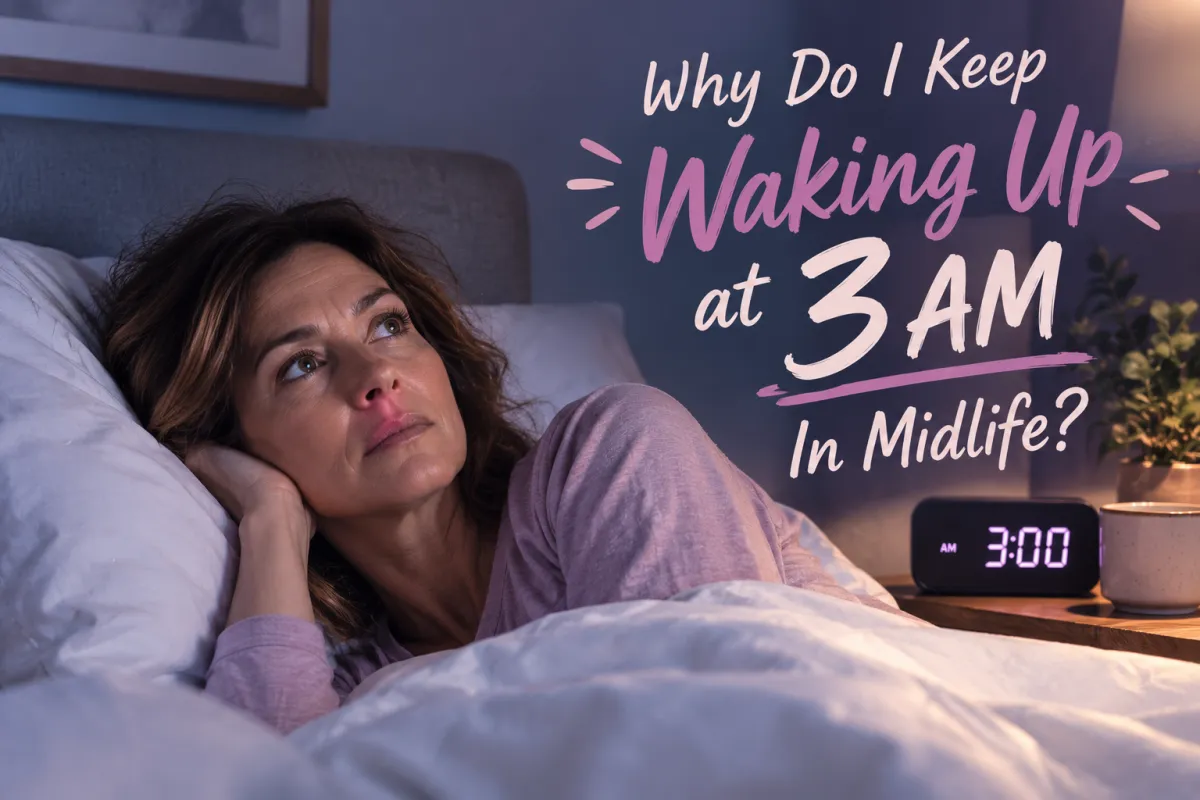
Why Do I Keep Waking Up at 3 AM in Midlife?
There is something about 3 AM and women in midlife.
I can't tell you how many times I've heard some version of this over the years: “I fall asleep just fine, but then I wake up around 3 AM and I'm wide awake.” Not 6 AM when the alarm is about to go off, and not midnight when you could still convince yourself you have plenty of night left. Three. In. The. Morning.
And once you're awake, apparently your brain decides this is an excellent opportunity to hold a staff meeting. We need to think about tomorrow's schedule, the kids, your mother, that email you forgot to answer, whether you paid the Visa bill, the weird thing your husband said at dinner, your health, your weight and, while we're here, perhaps something embarrassing you said at a Christmas party in 2009. By 3:17 AM, you've solved three problems that don't exist yet, diagnosed yourself with four medical conditions and possibly reconsidered your entire life.
Then the alarm goes off a few hours later and you're expected to function like a normal human being.
If this sounds familiar, you're certainly not the only woman asking, “Why does this keep happening?” And because we're talking about a woman in midlife, the answer she's often given is one word: hormones.
But after 30 years of taking care of women, I've learned to be suspicious of explanations that try to make one word carry the weight of an entire woman's biology. Hormones may absolutely be part of your 3 AM story. They just may not be the whole story.
First, 3 AM Isn't Magic
Let's clear this one up before the internet gives 3:00 in the morning its own diagnosis. There isn't a little biological alarm clock inside women that suddenly goes off at precisely 3 AM.
We move through different stages of sleep throughout the night, our sleep architecture changes as the night progresses, and brief awakenings are actually a normal part of sleeping. Sometimes you don't even remember them. The more interesting question is what happens after you wake up.
Maybe five years ago you rolled over and went right back to sleep. Now you wake up and your brain says, Excellent. She's conscious. Bring me the spreadsheets.
That's where I want us to get curious, because instead of asking, “Why do I wake up at 3 AM?” I'd rather ask, “What has changed that makes it harder for my body to stay asleep—or return to sleep—the way it once did?”
It sounds like a subtle difference, but it isn't. One question is looking for a quick answer. The other is looking for your story.
Yes, Your Changing Hormones Matter
Perimenopause and menopause can absolutely change sleep. Estrogen and progesterone aren't simply “period hormones,” and hormonal changes during this transition interact with systems throughout the body, including those involved in temperature regulation, mood and sleep.
For some women, the connection is fairly obvious. You're peacefully sleeping and suddenly you're hot. Not maybe I need to kick one foot out from under the covers hot. I'm talking why does my bedroom suddenly feel like the surface of the sun? hot.
Blankets off. Then you're cold. Blankets back on. Your spouse has now become an unwilling participant in some sort of menopausal blanket Olympics.
Of course that can disrupt sleep, but not every woman waking during the night is having dramatic night sweats, and that's where the conversation needs to get bigger.
Somewhere along the way, we've begun doing something in women's health that concerns me. A woman reaches midlife, something changes, and suddenly everything gets placed into the menopause bucket. Tired? Menopause. Weight changed? Menopause. Brain fog? Menopause. Waking at 3 AM? Menopause.
Could menopause be contributing? Absolutely.
But your hormones don't sleep alone.
Your Whole Life Climbs Into Bed With You
I want you to think about the day your body lived before you asked it to sleep. Did you eat regularly? How much coffee did you drink? Did you have wine with dinner? Were you sitting most of the day or did you exercise hard? Did you spend the evening staring at a screen? Were you worried about work? Did your teenager need you? Did your adult child need you? Did your mother need you? Did everybody need you?
Maybe you spent ten hours solving problems, making decisions, responding to messages, meeting deadlines and taking care of everyone else's needs, and then at 10 PM you climbed into bed and essentially said, “Okay body. Shut everything down.”
Sometimes I imagine the body looking back at us thinking, Seriously, Michele? You've had me running the emergency department all day and now you'd like a spa experience?
Biology doesn't work quite like that.
Your body doesn't draw a line between your “life” and your “health.” The life you lived today becomes part of the biological environment you carry into tonight, and this is one of the reasons I want women to understand that a changing hormone environment and everyday life aren't competing explanations. They interact.
Midlife biology may change the terrain, but your life is still happening on that terrain.
And Then There's Cortisol
Poor cortisol. If cortisol had a public relations department, I'd tell them it's time to hire somebody new.
The internet has turned cortisol into the villain of practically every midlife story. Can't sleep? Cortisol. Belly fat? Cortisol. Tired? Cortisol. Hungry? Cortisol. Probably if your dishwasher stops working tomorrow, someone on social media can explain how cortisol did that too.
But cortisol isn't inherently bad. We need it. Cortisol is part of our normal stress-response system and follows a daily rhythm; it helps us mobilize energy, respond to challenges and become alert for the day. The issue isn't that your body contains cortisol. The more useful conversation is about stress regulation, timing, sleep and the demands being placed on your system.
And stress isn't only emotional. Illness is stress. Pain is stress. Undereating can be a physiological stressor. Overtraining can be a stressor. Caregiving is stress. Constant stimulation is stress. Poor sleep itself becomes another stressor.
Sometimes I think high-achieving women become so accustomed to functioning under pressure that they stop recognizing pressure as pressure. It just becomes Tuesday.
You become incredibly good at staying “on”—respond, solve, manage, push, handle it, do the next thing—and that capacity may have helped you build a career, raise a family, run a business and take care of the people you love. But a body that's been asked to remain alert all day doesn't always become beautifully quiet simply because you turned off the bedroom light.
And when you briefly wake during the night, that very capable problem-solving brain may come right back online.
Hello, 3 AM staff meeting.
What About Blood Sugar?
This is another place where I'd like us to keep some nuance. Search the internet for 3 AM waking and before long you'll encounter a very confident explanation involving your blood sugar crashing, cortisol surging and your body waking you up.
Could nutrition patterns, glucose regulation, alcohol and metabolic health affect sleep? Of course. But that does not mean every woman who wakes at 3 AM is experiencing a blood sugar crash.
This is exactly how health information can become health misinformation: something that can happen quietly becomes the explanation for what is happening to everyone. That's a distinction I want us to become very good at recognizing.
Your clock cannot diagnose your glucose, and your clock cannot diagnose your cortisol.
3 AM is information. It isn't a diagnosis.
Since We're Here, We Need to Talk About the Wine
I know. I was hoping we could skip this part too.
A glass of wine in the evening may make you feel sleepy, and that's one reason people understandably believe alcohol helps them sleep. But falling asleep easily and getting restorative, uninterrupted sleep are not necessarily the same thing, and alcohol can contribute to more fragmented sleep later in the night.
So if your pattern looks something like wine with dinner, relaxed, fall asleep beautifully, and then—hello, 3 AM—I'm not telling you the wine caused your sleep problem. I'm asking you to become curious enough to find out whether it contributes to your pattern.
That difference matters to me because I don't want women walking around with another list of things they're doing wrong. I want women learning how to observe their own biology without judgment.
Curiosity gives us information. Shame rarely does.
There's Also Something I Don't Want Us to Miss
Not every midlife sleep problem is menopause, and not every sleep problem should be solved with another supplement, a new bedtime routine or hormone therapy without asking more questions.
Sleep apnea is one example. Women don't always present with the stereotypical picture people associate with sleep apnea, and risk increases around and after the menopausal transition. Repeated awakenings, significant daytime fatigue, snoring, gasping during sleep, morning headaches or waking with a dry mouth deserve attention.
Pain can interrupt sleep. Restless legs can interrupt sleep. Urinary symptoms can interrupt sleep. Certain medications can affect sleep. Mood disorders can affect sleep. Other medical conditions can affect sleep.
Sometimes understanding your body means making a small lifestyle adjustment, and sometimes understanding your body means recognizing, “This deserves a conversation with my healthcare provider.”
Health independence doesn't mean becoming your own doctor. It means understanding enough to ask better questions and participate meaningfully in decisions about your health.
Here's the Plot Twist
After all of this, you may be wondering, Okay Michele, so what is causing my 3 AM wake-up?
And my answer may initially feel unsatisfying: I don't know. Not from the clock.
Maybe hormonal changes are affecting your sleep. Maybe temperature regulation is part of it. Maybe chronic stress is keeping your system more alert. Maybe alcohol is fragmenting your sleep. Maybe caffeine is staying with you longer than you realize. Maybe you're waking to urinate. Maybe pain is involved. Maybe your environment isn't helping. Maybe there's an underlying sleep disorder. Maybe your brain has simply become exceptionally practiced at being “on.”
And quite often, it may not be one thing.
It may be the combination.
That's the part of women's health I think we've spent too long overlooking. We keep searching for the thing—the hormone, the supplement, the diagnosis, the food, the medication, the biohack—when your body isn't a collection of isolated departments and your hormones aren't operating in a vacuum.
Sleep talks to stress. Stress talks to metabolism. Metabolism talks to hormones. Hormones influence temperature and mood. Your daily behaviors influence all of them. And your life is happening right through the middle of the entire conversation.
This is why I'm far less interested in giving every woman the same answer than I am in teaching a woman how to find the patterns in her own story.
So What Do You Do Tonight?
Please don't create a 23-step nighttime routine. You'll end up lying awake worrying that you forgot step 17.
Instead, for one week, I want you to become a detective. Nothing fancy. If you're waking during the night, start noticing what surrounds those nights. Think about when you went to bed, how late you had caffeine, whether you had alcohol, whether you were hot when you woke, whether you needed the bathroom, whether you were hungry, whether your mind was racing, whether you were uncomfortable or in pain, whether the previous day had been unusually stressful, whether you snored or woke gasping, and how you felt the next morning.
You aren't trying to diagnose yourself.
You're collecting clues.
Because here's something I want women to remember: one night is a night. It may have been the wine, the late dinner, the argument, the hotel mattress, the sick child, the deadline, the dog, the full moon—who knows.
But when something keeps happening, now we have information.
Repeated patterns tell a story.
And once we can see the story, we can start asking much better questions about what your body might need. Maybe that's a change in your evening habits. Maybe it's addressing stress and recovery. Maybe it's a conversation about menopausal symptoms and whether HRT is appropriate for you. Maybe it's evaluating another medical contributor. Maybe it's several things working together.
That's why I want you to resist the temptation to diagnose yourself from one symptom—or one number on a clock.
Your body is always communicating, but understanding what it's saying usually requires us to listen to more than one sentence.
So the next time your eyes pop open and the clock says 3:00 AM, before deciding your cortisol is broken, your estrogen has abandoned you and your blood sugar is staging a revolt, get curious.
Because the goal isn't to become afraid of every signal your body sends. The goal is to become better at understanding those signals, seeing how they fit together and recognizing what the pattern might be telling you about the life your body has been living.
Stop guessing. Start understanding.
That's where better health decisions begin.
