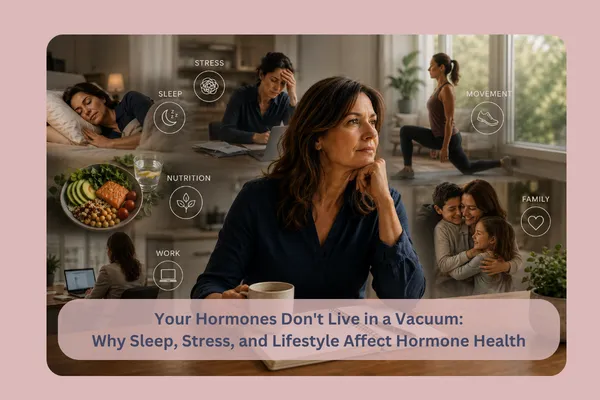
Your Hormones Don't Live in a Vacuum: Why Sleep, Stress, and Lifestyle Affect Hormone Health
If you've ever felt like you're chasing one hormone after another without finding real answers, this episode is for you. One of the biggest challenges I see in women's health today is that we've been taught to look at hormones as though they operate independently from everything else happening in our lives. We start wondering if estrogen is the problem, or cortisol, or thyroid, or insulin. We search for the one hormone that must be causing all of our symptoms, believing that if we can just identify the culprit, we'll finally have the answer.
I understand why so many women think this way because it's how much of women's health has been presented for years. But the reality is both more complicated and, thankfully, much more hopeful.
The truth is that your hormones don't live in a vacuum. They exist inside a body that is constantly responding to your environment, your sleep habits, your stress levels, your relationships, your workload, your nutrition, your recovery, your emotional health, and the season of life you're currently navigating. Your hormones are not functioning independently from the rest of your body. They are continuously communicating with every other system, responding to information, adapting to demands, and adjusting based on the life you're living every single day.
When we begin to view health through that lens, many of the symptoms that once felt confusing suddenly start making much more sense.
The Hormone Myth Most Women Have Been Sold
One of the biggest misconceptions women have been taught is that each hormone has its own separate job and operates largely on its own. We learn that estrogen is responsible for reproductive health, cortisol manages stress, thyroid controls metabolism, and insulin regulates blood sugar. While those descriptions aren't wrong, they're incomplete.
The body doesn't work in isolated departments.
I often think about hormones as the leadership team of a company. Every leader has a specific responsibility, but none of them operate without communication from the others. If one department begins struggling, it eventually affects the entire organization. Productivity changes. Communication changes. Outcomes change.
The exact same thing happens inside your body.
When sleep becomes disrupted, cortisol regulation begins to shift. As cortisol changes, blood sugar regulation often changes alongside it. When blood sugar becomes less stable, inflammation can increase. As inflammation rises, hormone signaling becomes less efficient. Before long, what may have started as one seemingly small issue has created ripple effects throughout multiple systems in the body.
This interconnectedness isn't just theory. Research on stress physiology and hormone regulation consistently demonstrates that hormonal systems communicate through complex feedback loops. What affects one hormone rarely affects only one hormone.
This is one of the reasons so many women become frustrated when they're focused on finding a single hormonal explanation for everything they're experiencing. Often, the issue isn't one hormone acting alone. It's the health of the entire ecosystem.
Why Sleep May Be the Most Powerful Hormone Strategy Nobody Is Talking About
One of the most fascinating discoveries in women's health research over the last several years is just how profoundly sleep influences nearly every aspect of our physiology.
Many women come to me believing that their hormones are causing their poor sleep. And to be fair, sometimes that's absolutely true. Declining progesterone, fluctuating estrogen levels, changing circadian rhythms, and nighttime temperature changes can all interfere with sleep quality during perimenopause and menopause.
What many women don't realize, however, is that the relationship works both ways.
Poor sleep doesn't simply result from hormone changes. Poor sleep can actually drive further hormone disruption.
When sleep becomes fragmented or insufficient, cortisol regulation becomes less predictable. Insulin sensitivity declines. Appetite-regulating hormones become altered. Inflammation increases. Recovery slows. Mental clarity suffers. Mood becomes less stable. Energy becomes harder to sustain.
Research examining sleep and metabolism in midlife women has found significant associations between sleep disturbances, metabolic dysfunction, and increased cardiovascular risk. In other words, poor sleep isn't simply making you tired. It's changing the way your body functions.
I've seen this play out countless times in practice. Women often arrive convinced they need a complicated hormone solution when one of the most powerful opportunities for improvement is restoring quality sleep. Yet many high-achieving women have become so accustomed to functioning while exhausted that they no longer recognize how much it may be affecting them.
We live in a culture that often celebrates pushing through fatigue. Many women wear exhaustion almost like a badge of honor until eventually their body begins demanding a different conversation.
The Cortisol Conversation Is Bigger Than Social Media Makes It Sound
If you've spent any time on social media recently, you've probably encountered countless messages suggesting that cortisol is ruining your life.
The reality is much more nuanced.
Cortisol is not the enemy. In fact, without cortisol you couldn't wake up in the morning, respond to challenges, regulate blood pressure, maintain blood sugar, or adapt to stress. Cortisol is a necessary survival hormone.
The problem isn't cortisol itself.
The problem is chronic activation.
And for many women, chronic activation has quietly become their normal.
This is where I want to share something personal because it's a pattern I've seen not only in my patients but also in my own life.
As women who lead, care for others, solve problems, and carry significant responsibility, we often become so accustomed to being needed that we stop paying attention to what it's costing us. There have been seasons in my own life where everyone seemed to need something from me. Patients needed answers. Family members needed support. Business decisions required attention. Life simply kept moving forward, and I kept moving with it.
From the outside, everything appeared to be functioning well.
But internally, I was operating in a nearly constant state of output.
What I've learned over time is that self-awareness may be one of the most powerful health tools we possess. Not because it magically changes our circumstances overnight, but because it allows us to recognize when our body has been communicating with us long before we were ready to listen.
Research consistently demonstrates that chronic stress influences multiple hormonal pathways simultaneously, affecting sleep quality, blood sugar regulation, inflammation, reproductive hormones, metabolism, and overall health.
Your body isn't failing.
Your body is adapting.
The question becomes whether those adaptations are helping you thrive or simply helping you survive.
Your Hormones Are Responding to the Life You're Living
One of the questions I ask women isn't simply, "What symptoms are you having?"
I also want to know what their life looks like right now.
Are they caring for aging parents? Are they navigating a demanding career? Are they sleeping six hours a night? Are they rushing from responsibility to responsibility without any margin for recovery? Are they carrying emotional burdens that nobody else knows about?
Because all of those things matter.
Your hormones respond to all of it.
Your body is continuously gathering information from your environment and making adjustments based on what it perceives. That reality helps explain why two women can have similar lab results and completely different experiences.
One woman may feel energetic, focused, resilient, and capable.
Another may feel exhausted, overwhelmed, disconnected, and depleted.
The difference often isn't found solely in the lab values. It's found in the broader context of their lives.
This is where health becomes much bigger than supplements, hormone replacement therapy, or laboratory testing. Those tools can be incredibly valuable, but they are only part of the conversation. We also have to understand the environment in which those hormones are attempting to function.
Menopause Is Not Just a Hormone Transition
For many years, menopause was viewed primarily through a reproductive lens. The conversation centered almost entirely around estrogen, progesterone, and hot flashes.
Today, the research is painting a much larger picture.
Menopause influences metabolism, brain function, cardiovascular health, bone health, muscle mass, inflammation, sleep quality, recovery, and energy production. In many ways, menopause is less of a purely hormonal event and more of a whole-body transition.
I believe this is one reason so many women feel blindsided by what they're experiencing.
Nobody told them that changes in focus, motivation, confidence, resilience, recovery, and energy might show up before the hot flashes ever did. Nobody explained that their body's entire operating system was adapting.
When women begin to understand that bigger picture, something important shifts.
They stop viewing themselves as broken.
Instead, they begin viewing their body as a system that requires support, understanding, and partnership.
And that's an entirely different conversation.
The Bottom Line
Maybe the goal isn't finding the perfect hormone level.
Maybe the goal is understanding the environment your hormones are trying to navigate every single day.
Because your hormones don't live in a vacuum.
They live inside your body.
And your body exists inside a real life.
A life filled with leadership, caregiving, relationships, purpose, responsibilities, stress, joy, grief, growth, and constant change.
The more we understand that bigger picture, the more empowered we become to work with our biology instead of feeling like we're constantly fighting against it.
And perhaps that's the conversation women have needed all along.
